
The Eisenhower Matrix Explained: 4 Quadrants & How Rule of Three Fixes the Urgency Trap
What is the Eisenhower Principle? Learn how the 4 quadrants (Important vs. Urgent) work, why the classic matrix fails in modern work, and how the Rule of Three enables consistent daily execution.
TL;DR / Key Takeaways:
The Eisenhower Principle categorizes tasks into two criteria: Importance (high strategic leverage) and Urgency (immediate time pressure), creating 4 quadrants: Do, Schedule, Delegate, and Delete.
The Real-World Flaw: Because of the psychological “Mere Urgency Effect,” our brains instinctively prioritize urgent trivialities (Quadrant III) and firefighting (Quadrant I) over long-term strategic progress (Quadrant II).
How Rule of Three Fixes It: We translate the matrix into 3 simple daily guardrails: Cap emergencies to max 1–2 slots (Q1), strictly require 1 strategic growth goal every day (Q2), and use an asynchronous Parking Lot for distractions & routine tasks (Q3).
We have all experienced this workday: You sit down in the morning determined to make progress on your most important project—a new strategy deck, your thesis, or core product architecture.
Yet within minutes of opening your laptop:
- A colleague pings you for a “quick question.”
- Your inbox floods with urgent requests.
- A client calls about a minor issue needing immediate attention.
By 5:30 PM, you feel completely drained. You checked off 35 items, but your actual core project remains untouched.
This is the exact dilemma that one of history’s most famous productivity frameworks was created to solve: The Eisenhower Matrix. But why do so many people still struggle to stick with it? And how does the Rule of Three bridge the gap between abstract theory and real-world execution?
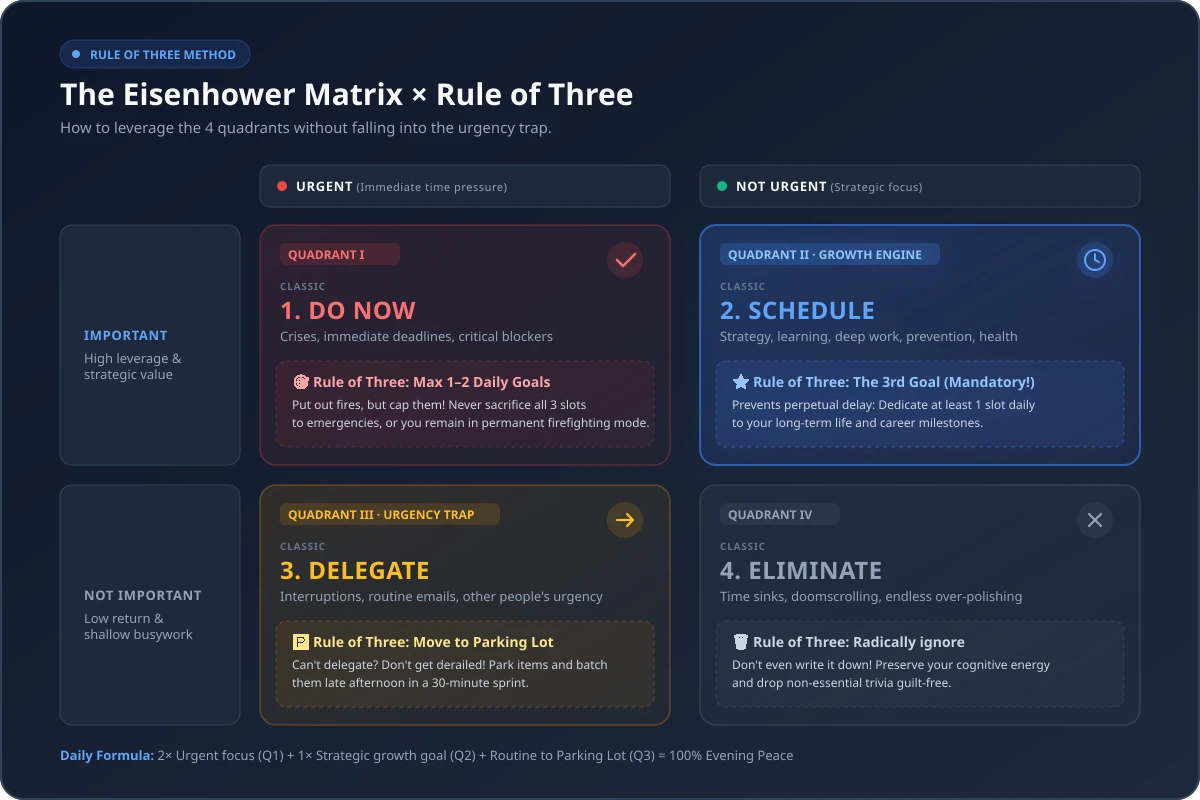
The Eisenhower Matrix at a Glance (Infographic)
Here is the classic 2×2 framework paired with its practical Rule of Three operational upgrade:
The Eisenhower Matrix × Rule of Three
The 4 classic quadrants – translated into an actionable daily system without the urgency trap.
DO
Crises, emergencies, pressing deadlines today
Put out fires, but cap them! Never sacrifice all 3 slots to emergencies, or you stay in permanent firefighting mode.
SCHEDULE
Strategy, learning, health, deep work, systems
Always postponed otherwise! Dedicate at least 1 of your 3 slots daily to a Quadrant II objective.
DELEGATE
Interruptions, other people's priorities, routine emails
Can't delegate? Clear it from your field of view and batch-process it in a 30-minute block late in the day.
DELETE
Time sinks, doomscrolling, nitpicking details
Doesn't even belong on the parking lot! Drop it guilt-free and preserve mental energy.
What is the Eisenhower Principle? (Origin & Definition)
The concept is credited to Dwight D. Eisenhower, 5-star general in World War II and the 34th President of the United States. Eisenhower was renowned for his capacity to organize vast amounts of critical intelligence under extreme pressure.
In a 1954 address, he quoted a former college president, articulating what became known as the Eisenhower Dictum:
“I have two kinds of problems, the urgent and the important. The urgent are not important, and the important are never urgent.”
— Dwight D. Eisenhower
Decades later, bestselling author Stephen R. Covey popularized the philosophy in his seminal book The 7 Habits of Highly Effective People, formatting it into the famous 2×2 coordinate grid.
Important vs. Urgent: The Crucial Difference
Standard to-do lists make the fatal assumption that all tasks are equal lines of text. Your brain naturally reaches for the line with the closest deadline or the highest noise. The Eisenhower Principle forces a conscious distinction:
┌──────────────────────────────────────────────┬──────────────────────────────────────────────┐
│                  IMPORTANT                   │                    URGENT                    │
├──────────────────────────────────────────────┼──────────────────────────────────────────────┤
│ • Serves long-term goals and strategic vision│ • Demands immediate reaction                 │
│ • Drives high-leverage compound results      │ • Driven by external factors (pings, alarms) │
│ • Often lacks an external immediate deadline │ • Triggers short-term stress (cortisol)      │
│ • Requires deep focus and cognitive energy   │ • Feels busy, but rarely creates real value  │
└──────────────────────────────────────────────┴──────────────────────────────────────────────┘
The 4 Quadrants of the Eisenhower Matrix
Combining these two dimensions yields four distinct action areas:
1. Quadrant I: Urgent & Important (Do First)
This quadrant holds crises, emergencies, and hard deadlines today.
- Examples: A production server outage, tax filing due at midnight, a critical client escalation, an urgent medical emergency.
- Classic Action: Do immediately yourself.
2. Quadrant II: Not Urgent & Important (Schedule & Protect)
This is the engine of long-term success. Every major career milestone, health improvement, and meaningful innovation lives here.
- Examples: Strategic roadmap planning, writing clean core software architecture, regular workout routines, studying fundamentals, relationship building.
- Classic Action: Schedule a dedicated block on your calendar.
Cognitive psychology studies reveal that individuals who spend over 60% of their mental bandwidth in Quadrant II report significantly lower chronic stress, higher job satisfaction, and faster promotion cycles. The catch: Because Quadrant II doesn’t sound an alarm, it is the first thing sacrificed when your day gets busy.
3. Quadrant III: Urgent & Not Important (Delegate)
This represents the greatest illusion of productivity in the workplace. These items create artificial adrenaline without moving your primary needle.
- Examples: Most incoming emails and Slack pings, status meetings without an actionable agenda, favors for colleagues, random phone calls.
- Classic Action: Delegate to someone else.
4. Quadrant IV: Not Urgent & Not Important (Delete / Eliminate)
Pure distraction and time sinks.
- Examples: Mindless social media rabbit holes during work hours, obsessing over slide formatting, rearranging folders for the third time this week.
- Classic Action: Eliminate and ignore ruthlessly.
Why the Classic Eisenhower Matrix Fails in Practice
While mathematically elegant on paper, millions of people abandon the matrix within weeks. Here is why:
1. The “Mere Urgency Effect”
Behavioral researchers at Johns Hopkins University proved a fascinating human bias: Humans systematically choose urgent tasks over important tasks, even when the important task provides objectively higher financial, intellectual, or personal payoffs.
Evolution primed our brains to react to immediate threats. A deadline in 15 minutes spikes dopamine and focus; a strategic goal for Q4 does not. As a result, Quadrant II systematically starves.
2. The Delegation Illusion
The textbook advice for Quadrant III is simply “Delegate!”
But who does an individual contributor, student, freelancer, or solo founder delegate to? Most modern knowledge workers have zero direct reports. When you cannot delegate Quadrant III, you end up doing it all yourself—and drown in trivia.
3. Classification Paralysis
Staring at 30 tasks and attempting to fit each one into one of four boxes creates cognitive friction. You spend half an hour organizing cards instead of producing work.
How the Rule of Three Upgrades the Eisenhower Matrix
The Rule of Three methodology doesn’t discard Eisenhower’s wisdom—it makes it cognitively manageable. Instead of juggling four open containers, it filters your workload every morning into three clear decisions:
Eisenhower Framework ────────> Filtered via Rule of Three ────────> Focused Daily Execution
(Which quadrant?)             (Max 3 Daily Targets)              (Deep Work & Evening Peace)
Here is how each quadrant is handled in practice:
1. The Sacred Slot: Exactly 1 Task for Quadrant II
This is the core breakthrough: At least one of your 3 daily targets MUST come from Quadrant II.
Whether it’s writing 1,000 words, completing a hard architectural redesign, or doing 45 minutes of exercise: by reserving one of your three daily slots for Quadrant II, it can no longer be pushed aside by urgent fires.
2. The Fire Extinguisher Cap: Max 2 Tasks for Quadrant I
Crises happen. When a server goes down or a key stakeholder needs an urgent fix, you must act.
However, the Rule of Three enforces a strict cap: Never allocate all 3 slots to emergencies. Capping urgent fires to 1 or 2 slots prevents reactive tunnel vision.
3. The Digital Parking Lot Instead of Delegation (Quadrant III)
Have no assistants to delegate to? Move Quadrant III tasks directly into the app’s Parking Lot.
They vanish from your direct focus area, freeing up your working memory. At 4:30 PM, run a single 30-minute batching session to clear them out in one swift sweep.
4. Quadrant IV Never Enters the App
Non-urgent, unimportant tasks should never even be recorded. They get no slot, no card, and no reminder. Dropping them guilt-free protects your most finite asset: mental clarity.
Every morning, choose:
- Max 2× Urgent Levers (Q1): What must get resolved today so nothing breaks?
- 1× Strategic Growth Target (Q2): What high-leverage objective advances your long-term success?
Everything else goes into the Parking Lot or gets crossed off permanently.
Escape the Urgency Trap Today
Focus on maximum 3 core goals, park routine trivia, and achieve true evening peace with the Rule of Three app.
Step-by-Step: Your Ideal Day with Eisenhower & Rule of Three
- Morning 3-Minute Routine:
Before opening Slack, email, or social media, open the Rule of Three App. - Answer the 2 Key Prompts:
- “What 1–2 pressing fires (Q1) must be extinguished today?”
- “What 1 strategic priority (Q2) will make today a compounding win?”
Record these 3 goals.
- Trigger Focus Mode:
Begin with your high-leverage task. Turn on the integrated timer, mute notifications, and work single-tasked. - Feed the Parking Lot:
Whenever a minor chore, incoming email, or distracting thought surfaces, jot it into the Parking Lot in 2 seconds and immediately resume deep work. - A Clear Evening:
Once your 3 targets are checked off, your workday is complete. No lingering guilt, no mountain of backlogged tasks.
Frequently Asked Questions (FAQ)
Who actually invented the Eisenhower Matrix?
The concept of separating “urgent” and “important” was stated by US President Dwight D. Eisenhower in 1954. The 2×2 matrix diagram was formally established and popularized by Stephen R. Covey in The 7 Habits of Highly Effective People.
What if I have 5 tasks that all feel urgent and important?
Ask yourself: “What is the realistic catastrophic downside if tasks 4 and 5 wait 24 hours?” Most supposed crises can wait until tomorrow without irreversible damage. Pick the 2 most critical for today, and put the others at the top of your Parking Lot for tomorrow.
Why is the Rule of Three better than a 4-box template?
Four-box templates easily accumulate dozens of items across every quadrant, leading straight back to decision fatigue and dopamine scatter. The Rule of Three enforces an intentional cognitive ceiling of 3 daily commitments.
Reclaim Your Focus. Master Today.
Designed for professionals, creators, and students who want to replace to-do anxiety with clear, focused momentum.